Days Over 30 degrees
In 2026, both spring and summer have been exceptionally hot across the UK. Five major heatwaves affected the country during these two seasons, contributing to the warmest summer on record and the third-warmest spring. This raises an important question: how does the persistence and intensity of this year’s heat compare with other notably hot years in the 21st century, and with the most recent 30-year average?
The figure below compares the number of days each year when temperatures reached or exceeded 30°C. In a typical year, London records around five such days, while Cambridge and the Fens usually see about two or three. Across most of Wales, northern England, Northern Ireland, and Scotland, days of ≥30°C are generally rare or do not occur at all. In especially warm years, however, these totals increase markedly.
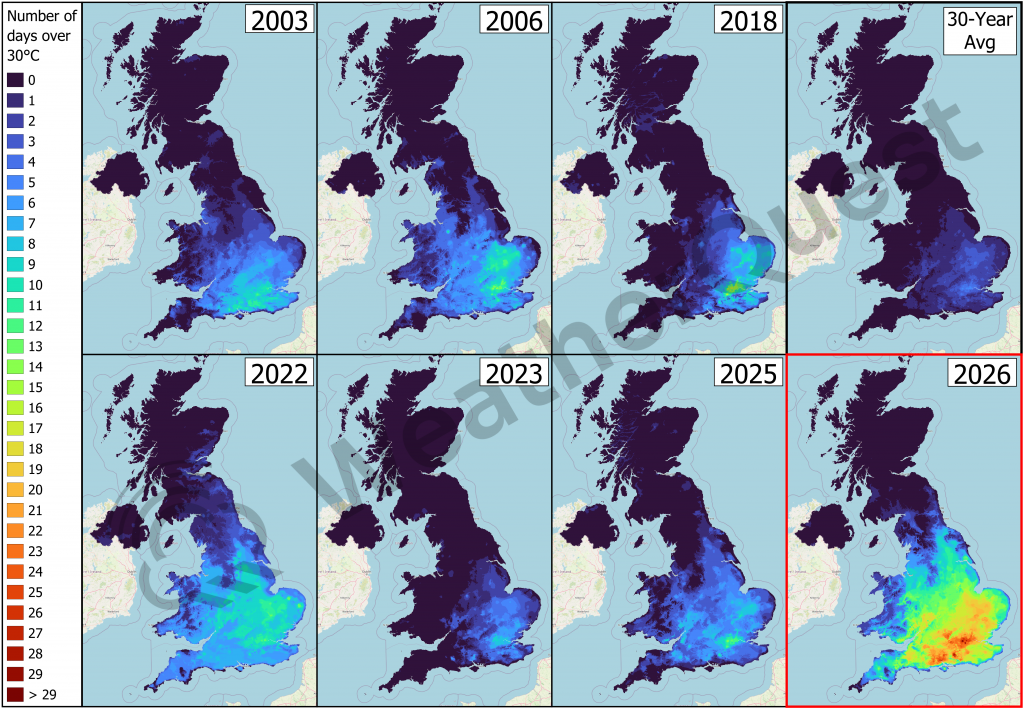
Several recent hot years illustrate this pattern. During the summer heatwave of 2003, which caused around 2,000 deaths in the UK, many areas in the South had around ten to thirteen days with temperatures ≥30°C, while most of England experienced more than five such days. In 2018, the third-hottest summer on record, Kew Gardens recorded eighteen days ≥30°C, and much of London exceeded ten. Across eastern England, totals were widely above seven. In 2022, when the UK exceeded 40°C during the July heatwave, the number of days ≥30°C was widely above nine, with hotspots again reaching the low teens. In 2025, the second-warmest summer on record, most of London recorded ten days ≥30°C, while the rest of England and Wales generally ranged from low to high single figures.
Against this context, 2026 stands out as particularly extreme. Teddington and Heathrow both recorded thirty days ≥30°C, while the rest of London and Southampton recorded around twenty-five. Across much of southern and central England, totals exceeded twenty days. In the Southwest, including areas that would not usually reach 30°C, fifteen days reached or exceeded that threshold. Even as far north as York, around ten days reached at least 30°C. Understandably, the mean temperature anomalies for summer 2026 were more than 2.48°C and 2.22°C above average in England and Wales respectively, compared with 1.69°C and 1.43°C in 2025.
Although summer has ended and September 2026 does not show signs of any weather breaching 30°C, the UK maximum October temperature ever recorded in the UK was 29.9°C, recorded on the 1st of October 2011 at Gravesend in Kent. It is therefore not impossible that more ≥30°C days could be recorded in 2026.
As the climate continues to warm, years like 2026 are likely to become less exceptional and more familiar. Although natural variability will still drive summer weather going forward, extreme heat is becoming more frequent, more persistent, and more widespread across the UK. 2026 therefore may be a glimpse of the hotter summers that are increasingly likely in the future.