Lightning
In the next instalment of our series on our favourite weather phenomena we will be exploring lightning!
One of the most important uses for an accurate forecast is to maintain health and safety, not only for those working in harsh weather conditions, but also for the general public. One of the largest risks to our clients, especially those working offshore and at height, is lightning, which can often strike from a very fast developing thunderstorm system, or even without warning (a rogue strike). Lightning poses not only a risk to life, as strikes that hit vital infrastructure can also cripple communities and services until repairs are made. Globally, there are an average of 7 million lightning strikes every day, each discharging up to 200,000 amperes and 300 million volts [1]. Despite its dangers, lightning is still a fascinating phenomenon, with powerful, intimidating and awe-inspiring displays that many people love to watch. But what is lightning, and how does it form?
To create lightning, you need lots and lots of energy in the weather system. This normally comes from cumulonimbus clouds, large thunderstorms generated from warm surfaces on the earth. This warm surface thrusts moist air upwards through convection, and the moisture in the air condenses out as it cools, turning into a cloud. If there is enough energy in the system, this moisture continues to be lifted higher and freezes into ice, sometimes turning into hail. When the hail has enough mass it falls to the ground, hitting the lifting ice particles as it passes. This transfers electrons from the lifting particles, creating a negative charge in the hail and a positive charge in the rising ice particles. As the hail continues to fall, it creates a difference in charge within the cloud from the bottom (negative) to the top (positive). The negative charge at the bottom of the cloud repels the electrons on the earth’s surface, making it have a positive charge and attracting the electrons at the base of the cloud. A lightning strike occurs when electrons shoot to the ground, creating the bright flash and shockwave that becomes thunder [2, 3,4]. Lightning does not have to always impact the ground however, and most lightning is actually intra-cloud (IC), meaning the lightning discharges from a negative charge to a positive charge within the cloud or one neighbouring it. This equalises the charge until it builds up again and more lightning can occur [4].
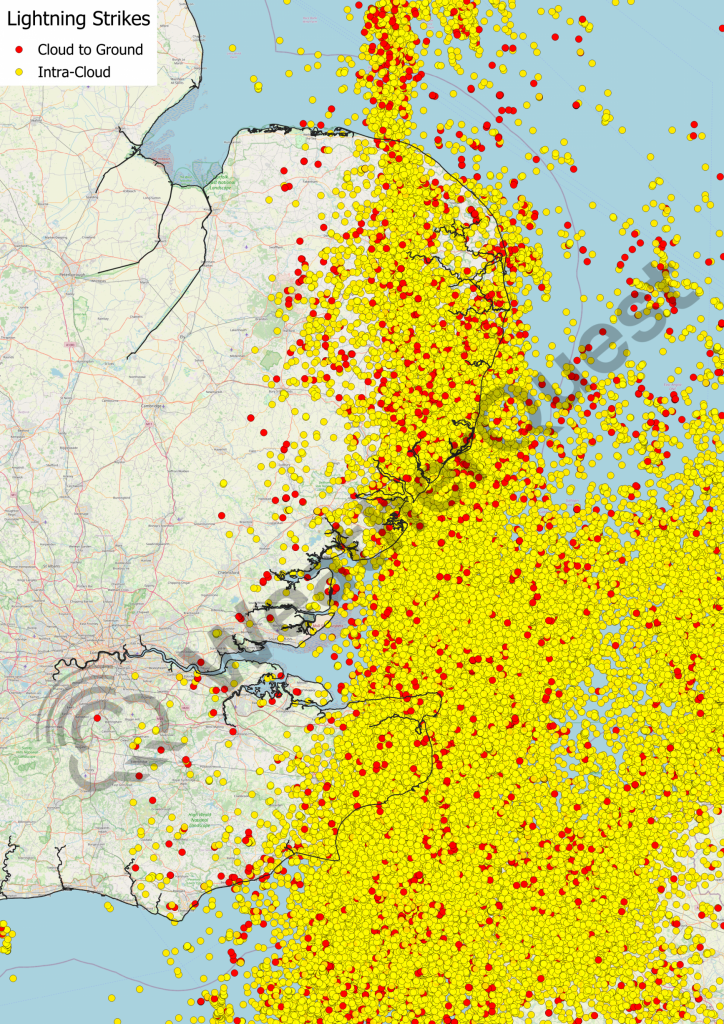
One of the most active lightning days the UK had in recent history was on the 13th of June, 2025. Over the custom domain WeatherQuest have, which covers northern France and the British Isles, 358,362 lightning strikes were recorded over a 24-hour period (using Meteorage lightning data). Out of all of this lightning, 93% of it was IC, with 25,621 being cloud-to-ground (CG) (see the image below for the strike coverage).
The main reasons why IC strikes are more common is due to the distance between the opposing charges, air insulation and cloud shielding. It is much easier for lightning to discharge within the cloud where the opposing charges are right next to each other, not through the surrounding air which is a natural electrical insulator. The base of the cloud also provides some shielding in the form of a positive charge, meaning it is much more difficult for lightning to strike through this to the ground below [5]. To determine the type of lightning that has occurred, global lightning detection systems primarily use electromagnetic waveform recognition, as CG and IC strikes discharge slightly differently [6].
As thunderstorms are very dangerous, it is important to stay safe during them, and depending on the activity you are doing there are different things you can do to help yourself. Try to find shelter first, or if impossible, keep away from low lying and underground areas that could flood rapidly. As the storm passes over, avoid using landlines or anything handheld that is plugged into the mains. If you are outside, avoid activities involving metal objects and large bodies of water, and if you are exposed, squat down to the ground with your hands on your knees with your head tucked between them [7]. Even once the thunderstorm has passed and there are blue skies above, if you can hear thunder, you are still at risk from a “bolt from the blue”. This occurs when a lightning strike begins from within the cloud but travels horizontally for a few miles before striking the ground [8].
So, the next time you find yourself close to a thunderstorm, remember to admire the light show safely, and remember the impressive science behind how each flash of lightning is created!
If you want to find out some more information about the fascinating phenomenon that is lightning, please use the links to the references below.
[1] Meteorage (2026a). Understanding thunderstorms and lightning. Available at: https://www.meteorage.com/understanding-thunderstorms-and-lightning/ (accessed: 04/06/2026)
[2] Met Office Press Office (2025). What is lightning and how does the Met Office monitor it? Available at: https://www.metoffice.gov.uk/blog/2025/how-the-met-office-monitors-lightning (accessed: 04/06/2026)
[3] Met Office (2026a). Types of Weather: Thunder and Lightning.Available at: https://weather.metoffice.gov.uk/learn-about/weather/types-of-weather/thunder-and-lightning (accessed: 04/06/2026)
[4] NOAA National Severe Storms Laboratory (2026). Severe Weather 101: Lightning Basics. Available at: https://www.nssl.noaa.gov/education/svrwx101/lightning/ (accessed: 04/06/2026)
[5] National Weather Service (2026). Understanding Lightning Science. Available at: https://www.weather.gov/safety/lightning-science-overview (accessed: 04/06/2026)
[6] Meteorage (2026b). Frequently Asked Questions. Available at: https://www.meteorage.com/faq/ (accessed: 04/06/2026)
[7] Met Office (2026b). Stay safe in thunder and lightning. Available at: https://weather.metoffice.gov.uk/warnings-and-advice/seasonal-advice/health-wellbeing/stay-safe-in-thunder-and-lightning (accessed: 04/06/2026)
[8] NOAA National Severe Storms Laboratory (2026). Severe Weather 101: Lightning Types. Available at: https://www.nssl.noaa.gov/education/svrwx101/lightning/types/ (accessed: 04/06/2026)