Nacreous Clouds
For our second instalment of our 25th Anniversary Weather Phenomena celebrations, we will be looking into nacreous clouds!
Nacreous clouds, otherwise known as mother-of-pearl clouds, are a type of cloud known as Polar Stratospheric Clouds (PSCs). They form in the stratosphere, 15 to 25 km above the polar regions when stratospheric temperatures drop below -78 °C, therefore mainly during winter. They are made of similarly sized very fine ice particles that scatter sunlight to produce clouds with a luminescent and iridescent appearance [1,2,3].
The height at which they are formed means that these clouds remain lit by the sun a couple of hours after dawn and before dusk. They are most likely to be seen at places in the higher latitudes and when the sun is between 1° and 6° below the horizon. Although it is possible to see these types of cloud in the UK, they are very rare and require specific atmospheric conditions. The polar vortex, a set of strong winds which keeps the coldest temperatures over the poles needs to be displaced and sit over the UK, allowing the stratospheric temperatures above the UK to reach the threshold needed to produce the ice crystals. This also means that during the time at which they will most likely be visible, the weather in the UK would be very cold and very dry [1].
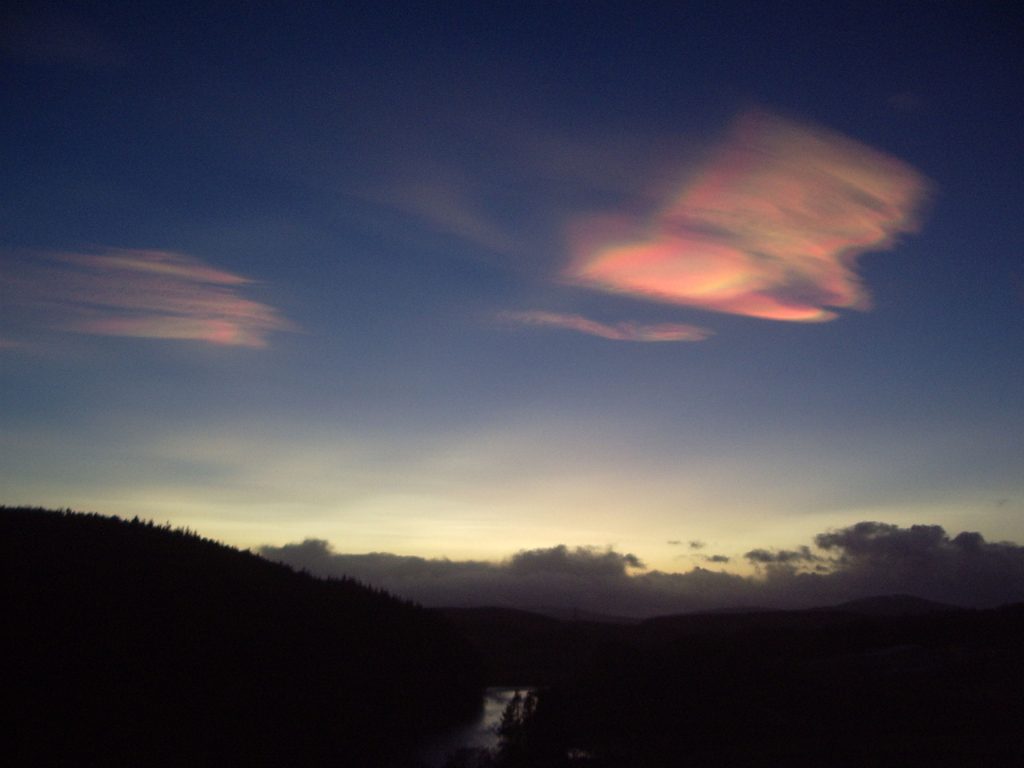
As mentioned above, nacreous clouds are one of two types of PSC, which differ according to their chemical composition and temperature of formation. Nacreous clouds are specifically formed entirely from water ice and at temperatures at or below -78 °C and are completely safe for our atmosphere. The other type, super-cooled stratiform acid-water PSCs, are formed from an ice made up of water, nitric acid and sulfuric acid in temperatures between -70 to -73 °C. They have a different appearance, looking almost hazy, and are linked to ozone depletion [3].
Due to the colourful appearance of nacreous clouds, there have been times when they have been confused with the aurora borealis. Back in 2016, during a bout of winter storms, residents in Scotland reported sights of the aurora to AuroraWatch UK at Lancaster University. The conditions were not correct for the aurora to appear, and so it was suspected that the residents had been viewing nacreous clouds. The recent storms had kicked enough moisture up in to the stratosphere to enhance the chance of seeing these clouds, giving people across Scotland some colourful displays [4]!
If you would like to read some more about nacreous clouds, please use the links below:
[1] Met Office (2026). Unusual cloud formations. Available at: https://weather.metoffice.gov.uk/learn-about/weather/types-of-weather/clouds/unusual-cloud-formations/index (accessed: 12/05/2026)
[2] Australian Antarctic Program (2003). Polar Stratospheric Cloud (PSC) Observations. Available at: https://www.antarctica.gov.au/about-antarctica/ice-and-atmosphere/atmosphere/clouds-and-radiation/polar-stratospheric-clouds/observations/ (accessed: 12/05/2026)
[3] Australian Antarctic Program (2024). Polar Stratospheric Clouds. Available at: https://www.antarctica.gov.au/about-antarctica/ice-and-atmosphere/atmosphere/clouds-and-radiation/polar-stratospheric-clouds/ (accessed: 12/05/2026)
[4] BBC News (2016). Colourful nacreous clouds spark aurora borealis reports. Available at: https://www.bbc.co.uk/news/uk-scotland-highlands-islands-35470260 (accessed: 12/05/2026)