Hoar Frost
Let’s continue our 25th Anniversary celebrations with another of our favourite weather phenomena, hoar frost!
In meteorology there are many ways in which frosts can be broken down into types. Two of the most common you will hear are air frosts and ground/surface frosts. Quite simply, air frosts occur when the 1 m air temperature drops below 0 °C and are typical during a winter cold spell. Ground/surface frosts occur when the ground, trees, structures or objects have surface temperatures below 0 °C. In conditions where the ground cools faster than the air above it (such as a calm and clear spring night) a ground frost can form without an air frost. Another, more unofficial type is grass frosts, which occur on vegetation and other specific surfaces close to the ground in a similar way to ground frosts. The difference here being that some surfaces such as roads and concrete can hold on to their heat better, resulting in only the certain surfaces reaching below 0 °C [3].
A hoar frost can be considered a specific type of ground/surface frost. They mainly occur on cold and clear nights, especially during winter, and result from surface temperatures being below freezing. When the surrounding air comes into contact with the surface, it reduces to below its dew point – the moment at which moisture condenses out of the air. As the surface is so cold, this moisture instantly freezes, producing tiny ice crystals, accumulating as more vapour is frozen out of the air [1]. Due to the speed at which the moisture is frozen, some air is also trapped within the ice crystals. This leads to the very characteristic white ‘feathery’ look to the hoar frost, with the size of the frost growth determined by how much moisture there is in the air [2,3]. In fact, the word hoar comes from Old English meaning “aged”, and refers to the frost looking like white/grey hair!
This type of frost can produce landscapes with a very picturesque wintry feel, and can be absolutely stunning in the sunlight!
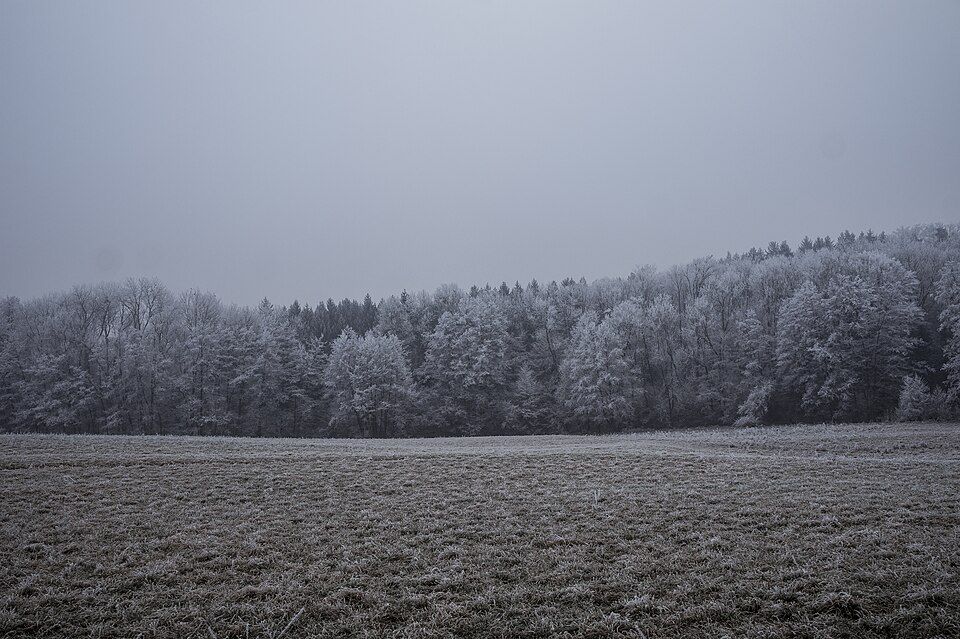
Despite their look, being a type of ground frost means hoar frosts can create a risk of slipping/skidding, and so action may need to be taken to melt the frosts in high footfall/traffic areas. Ground temperatures are one of the things included in our IceQuest service forecast, and is used to keep people safe during the cold half of the year when frost and ice can be present!
Have a read through the articles below if you’d like to find out more about hoar frosts:
[1] Emilie Bonnevay (2019). What is hoar frost and how does it form? Available at: https://www.woodlandtrust.org.uk/blog/2019/02/what-is-hoar-frost/ (accessed: 12/05/2026)
[2] Royal Meteorological Society (2016). How does hoar frost form? Available at: https://www.rmets.org/metmatters/how-does-hoar-frost-form (accessed: 12/05/2026)
[3] Met Office (2026). What is frost and ice? Available at: https://weather.metoffice.gov.uk/learn-about/weather/types-of-weather/frost-and-ice (accessed: 12/05/2026)