Radiation Fog
Next up on our 25th Anniversary celebratory exploration of our favourite weather phenomena is radiation fog!
Fog is caused by the same mechanism in which clouds are formed, but close to the ground: moisture in the air cools and condenses to form suspended water droplets. In order to be called fog, the number of these suspended droplets needs to be dense enough to reduce visibility to below 1 km [1, 2]. There are many different types of fog, each with different formation processes, including:
- Radiation fog
- Valley fog
- Advection fog
- Upslope fog
- Evaporation fog
- Freezing fog
- Coastal fog
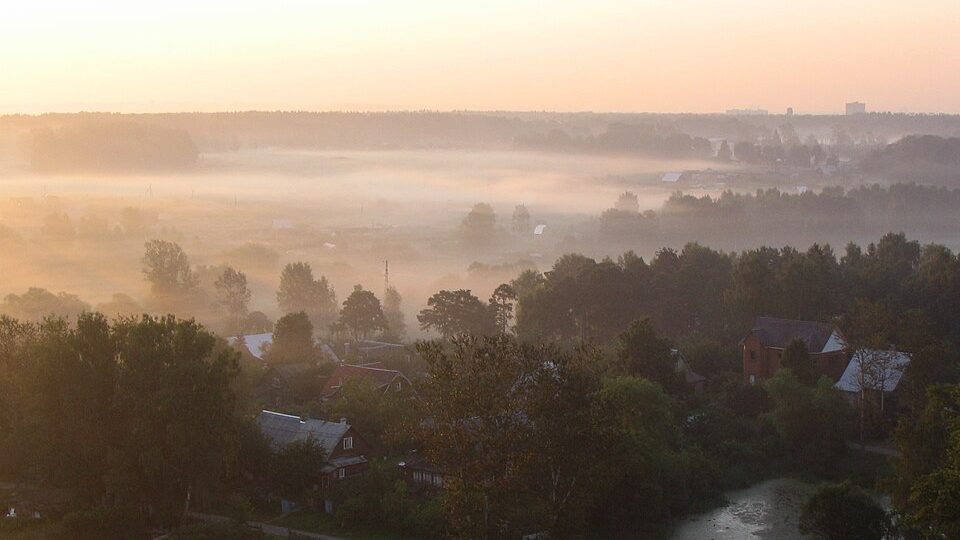
Radiation fog specifically is a common type that mainly occurs at night during autumn and winter in the UK. When the land surface cools down in the evening and overnight, it also cools the air just above, causing it to reach its dew point. This triggers the condensation of the moisture held within the air, creating the fog.
Clear sky conditions lead to more efficient ground cooling due to the absence of clouds which normally stop heat from escaping into space and reflect it back to earth. This therefore increases the chance of a radiation fog forming [2]. There also needs to be very little wind, as winds mix up the air above the ground surface, meaning it can never cool to its dew point. Finally, the moisture content of the air mass involved needs to be high enough for water to condense out; If it is too dry, a fog will never form. If the temperature is very low, radiation fog can often become a freezing fog, where the water droplets are supercooled and freeze on any surface they touch to produce rime [3].
Radiation fog normally clears soon after the sun rises, due to the warmth from the sun, but temperatures can remain cold enough or the fog can be thick enough to remain throughout the day. High elevation areas also have the risk of the fog not dissipating, as the sun can be blocked from ever reaching the surface, or the surfaces remain cold even if it does [3].
Reduction in visibility can have a dramatic impact on our lives and the world around us. The aviation industry can be disrupted with increased risk during take-off, landing and taxiing, potentially causing delays, diversions and accidents. Road vehicles may need to reduce speed and use fog lights as the risk of accidents increases, especially if the fog is patchy and only in certain areas. And although not radiation fog, the maritime industry relies on foghorns, radar and lighthouses to stay safe during very foggy sea conditions. Even when in harbour or port, processes often have to be reduced or delayed to keep the boats and crews safe. All of these impacts can be exacerbated if the fog develops into a freezing fog, introducing ice into the hazards experienced [4].
Despite all these impacts, fog (and visibility in general) is incredibly difficult to forecast, as multiple factors need to be considered, including but not limited to: wind speed and direction, cloud cover, strength of the sun, sunshine hours, rainfall, ground temperature and moisture, maximum daytime air temperature, moisture content of the air and the local topography. Only one condition needs to be slightly different from the forecast for the whole fog forming system to be influenced [1].
If you would like to find out more about fog, and the different types there are, use the links below:
[1] Met Office (2026). What is fog? Available at: https://weather.metoffice.gov.uk/learn-about/weather/types-of-weather/fog (accessed: 12/05/2026)
[2] Met Office Press Office (2025). Mist, fog, and haze: What’s the difference? Available at: https://www.metoffice.gov.uk/blog/2025/whats-the-difference-between-mist-fog-and-haze (accessed: 12/05/2026)
[3] Kirsty McCabe (2022). Foggy tales. Available at: https://www.rmets.org/metmatters/foggy-tales (accessed: 12/05/2026)
[4] BBC Bitesize (2026). How does fog affect our daily lives? Available at: https://www.bbc.co.uk/bitesize/articles/zrnrbqt (accessed: 12/05/2026)