Solar Optical Phenomena
Continuing our series of our favourite weather phenomena for our 25th Anniversary celebrations, we will be looking into Solar Optical Phenomena!
Being our primary source of light and energy, the sun plays a massive role in affecting the weather around us; short wave radiative heating impacts regional temperatures, and these regional differences in temperature influence rising/falling air, leading to synoptic pressure systems that control our wind speeds and rainfall. However, on a much finer scale, when atmospheric conditions are just right, the light from the sun can react in many ways to produce an array of optical phenomena.
Occurring on bright and sunny days, ice crystals suspended in the atmosphere can act as prisms which either refract or reflect the sun’s light into bright and colourful displays, depending on the viewers’ location in relation to the sun. These crystals are mainly found in the form of cirrus clouds, linking back to our previous post [1]. Therefore, when the sun is behind a thin and wispy layer of cirrostratus, some form of optic phenomena is likely to be seen, including many different bright circles, arcs and spots. As there are too many to mention here, we will only go through a couple.
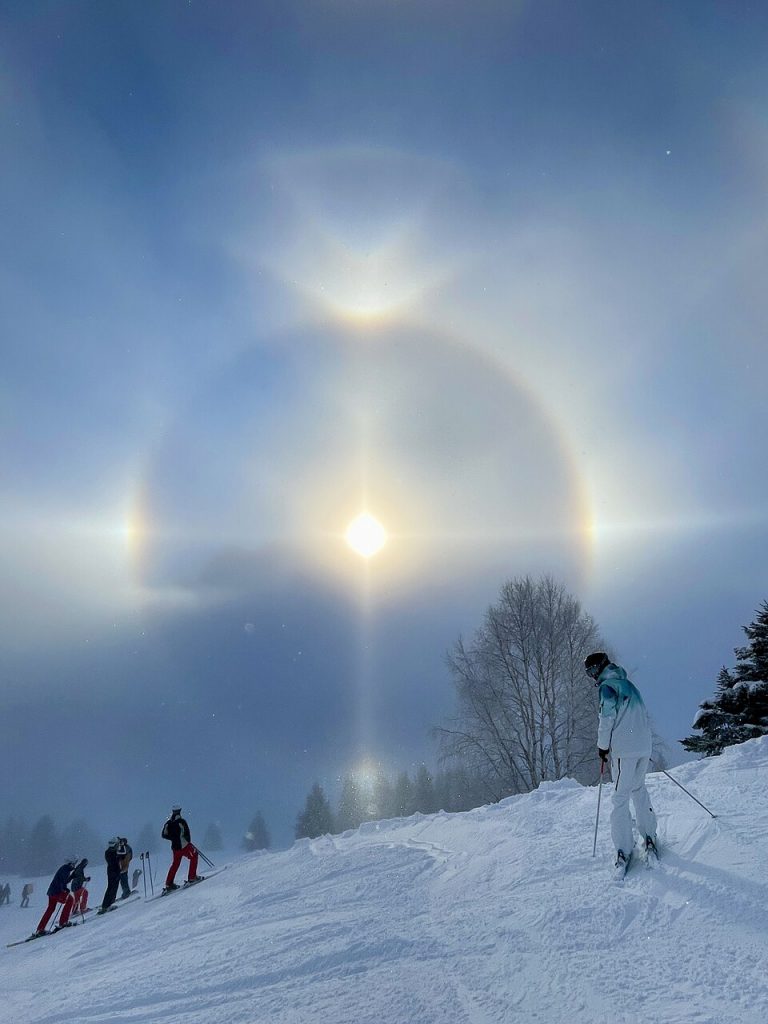
One of the more noticeable (and frequent) is the 22° halo, a bright circle that surrounds the sun with a slight red colour to its inside edge. Along this circle, to its left and right, are parhelia, otherwise known as sun dogs. These are bright spots that can often be seen even without the full 22° halo, and are also very common [1, 2]. Stretching out from either side of the sun dogs is the parhelic circle (normally the full circle is not seen), at the same altitude as the sun. Directly above and below the sun are tangent arcs, ‘V’ shaped bright lines that change shape as the sun rises/sets. When the sun is high in the sky, these tangent arcs create another ‘circumscribed halo’, just outside of the 22° halo [2].
Some of the most colourful optics come from the circumzenithal and circumhorizontal arcs, which appear directly above and below the sun respectively, much higher and lower than the 22° halo. They appear as rainbows (but technically are not, due to that curve towards the sun, with the innermost colour starting with red. This means that the circumzenithal arc looks like an ‘upside-down rainbow smile’ and is best seen when the sun is low in the sky. Conversely, the circumhorizontal arc is best seen when the sun is very high in the sky. This type of arc makes any cirrus clouds across its arc of formation turn prismatic. Due to the height the sun is required to reach however, the circumhorizontal arc is less common the further away from the tropics you get and is never seen above 55° latitude [1, 2].
There are many other optical phenomena related to the sun, moon and stars, and if you’d like to find out more, head over to either of the references below. There are some fantastic descriptions, images and simulations about the optical phenomena discussed, including some even rarer occurrences. Finally, it must be said that great care and caution should be taken when viewing any/all these optical phenomena, and you should never look directly into the sun, especially through a camera viewfinder!
[1] Les Cowley (2026). Atmospheric Optics: Ice Halos. Available at: https://www.atoptics.org.uk/halosim.htm (accessed: 11/05/2026)
[2] Cloud Appreciation Society (2026). Cloud Library: Optical Phenomena. Available at: https://cloudappreciationsociety.org/cloud-library/ (accessed: 15/05/2026)